My Account | View Cart | Checkout

About Diastasis

video
  1. TESTIMONIALS
  2. JULIE ON TELEVISION TALKING ABOUT DIASTASIS
  3. INSTRUCTIONS
    1. BAKS BASICS
    2. WEARING A SPLINT
    3. CHECKING FOR A DIASTASIS
  4. DEFINITION OF DIASTASIS
  5. CAUSE OF DIASTASIS
  6. EFFECT OF DIASTASIS ON BODY
  7. EFFECT OF CLOSING DIASTASIS ON BODY
  8. TIME PERIOD TO CLOSE DIASTASIS
  9. SPLINTING GUIDELINES
  10. DIASTASIS AND HERNIA
  11. DIASTASIS AND TUMMY TUCK
  12. INCIDENCE OF DIASTASIS IN MEN
  13. FREQUENTLY ASKED QUESTIONS (Q & A)

Want to see Julie live on television? On this show she will:

    1. Tell you about the cause of a diastasis and the effect on your body
    2. Demonstrate the three Tupler Technique exercises
    3. Show you how to get up and down correctly
    4. Show you how to hold a splint and wear a splint.
Watch Julie Tupler talking about diastasis recti and the Tupler Technique click here to view. This piece is 30 minutes and takes longer to load. To help the movie load faster, when the page opens, slide the status bar to the right under the video screen.

INSTRUCTIONS

    1. BAKS Basics sheet (click here to download)
    2. Wearing a splint (click here to download)
    3. Checking for Diastasis

back to top ^

CHECKING FOR DIASTASIS

A diastasis can be checked both during and after pregnancy. The object is to determine how many fingers will fit in the space between the two recti muscles. You also want to determine the condition of the connective tissue. The deeper your fingers will go towards your spine, the weaker the connective tissue. If you feel a pulsing while you are checking, this is a sign of very weak connective tissue. Start with your middle three fingers. You will also want to measure your waist before you start on the program. This measurement will get smaller as the muscles start coming together.

Lie on your back with your knees bent. Place your fingers in your belly button. Your fingers should be pointing in the direction of your toes.
Relax your abdominal muscles and lift your head. If you are holding your abdominal muscles in as you check it will give you a false reading as this will make the diastasis appear smaller. The muscles will get closer together the higher you lift your head.

To get a more accurate reading, it is important to check yourself when you first start feeling the muscles coming together. You might have to come up and down a few times so you can feel how the muscles work. If you don’t feel the two ridges of the muscles with 3 fingers you may have to put more fingers in. If you see the football- like ridge you should start by using 4 to 5 fingers. You may even have to use 2 hands if your diastasis is very large.

DEFINITION OF DIASTASIS

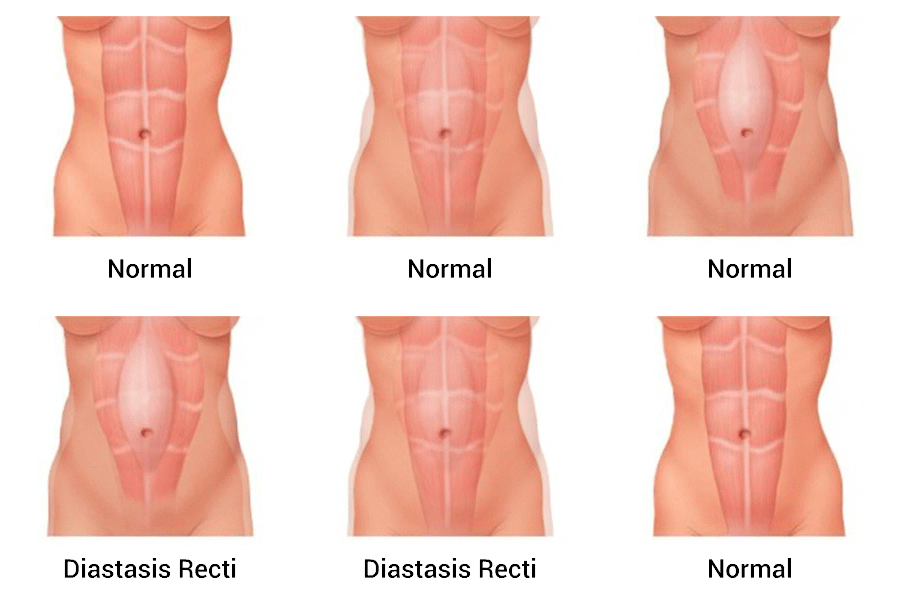
A diastasis is a separation of the rectus abdominis (outermost abdominal muscles). When these muscles separate the connective tissue that joins them stretches sideways. The more it stretches sideways the thinner and weaker it becomes.

back to top ^

CAUSE OF DIASTASIS
Forceful forward pressure on the weak spot (belly button) of the connective tissue from:

  1. Doing crunches
  2. Pilates 100's
  3. Pregnancy

Beer belly or "guy gut"

EFFECT OF DIASTASIS ON BODY

The function of the outermost muscle is to support your back and your organs. When the muscles separate this support system is weakened causing low back pain and the "mummy tummy." The mummy tummy is actually your protruding organs. They are protruding because they are being supported by a thin (saran wrap-like) piece of connective tissue instead of your muscles if they were together. If there is trauma to the abdominal area and the connective tissue is torn away from the muscle, a ventral hernia can develop and surgery will be required.

EFFECT OF CLOSING DIASTASIS ON BODY
Closing the diastasis will give you a flat belly, a smaller waist and relieve any back problems you are having.

back to top ^

TIME PERIOD TO CLOSE A DIASTASIS
The amount of time it takes to close a diastasis depends on two things:

  1. Your particular diastasis
  2. Your commitment to doing the 4 step research-based Tupler Technique program

To determine the severity of your diastasis you need to know two things:

  1. The distance between the two muscles. The wider the diastasis the longer it takes to close it.
  2. The condition of the connective tissue. The further your fingers go into your belly, the weaker the connective tissue. The weaker the connective tissue the longer it takes to heal. As the muscles come together the connective tissue will become shallower.

We recommend making a six week commitment to the program. You may not entirely close the diastasis, but you will definitely see improvement with it getting smaller. Start the program by measuring the diastasis and your waist. After six weeks measure again and you will be pleasantly surprised! Our new Tupler Technique Guidebook gives a chart of all the exercises you need to be doing each day and the progression each week for six weeks.  

A diastasis can be closed no matter when or how it was created with the Tupler Technique.

back to top ^

SPLINTING GUIDELINES

Purpose of splint
The splint is specifically designed to treat diastasis recti, a common condition resulting from pregnancy. The purpose of the splint is to help approximate (pull together) the two halves of the outermost abdominal muscle (recti), making the recommended Tupler Technique exercises more effective. It also helps heal the weakened connective tissue.

Wear it all the time under your clothes
A splint needs to be worn under your clothing and over a camisole or fitted undergarment to hold it in place better. Our clients get the best results in closing a diastasis when they wear the splint all the time. You are constantly using your core muscles when performing your activities of daily living. One of the steps of the Tupler Technique program is engaging the core muscles during these activities. So if you are wearing a splint, the starting position of the muscles will be closer together when the muscles are engaged. This then helps speed up the process of closing your diastasis.

Putting it on Correctly
First, the splint is placed on the back with soft velcro facing out. Then, the right hand pulls the left side of the muscle with the splint towards the middle. The left hand holds that pull as the right hand Velcros the end in the back on top. The left hand pulls the right side of the muscle with the splint towards the middle. The right hand holds that pull as the left hand velcros the end in the back on the bottom. This cross-over action creates the approximation (pulling together) of each side of the recti towards the middle which encourages the expedited healing of diastasis.

How is the splint different from a girdle or control top pantyhose?
The purpose of other girdles or bands is compression or bringing the abdominal muscles back towards the spine. The purpose of the Diastasis Rehab Splint is to approximate or pull the two halves of the muscles closer together. The splint is worn between the bottom of the rib cage and the top of the hip bones, so each side of the recti can be brought towards the middle. The Tupler Technique trains your core muscle to do the work of bringing your belly to the spine for a flat tummy. Wearing a girdle lets the girdle do your ab work for you!

back to top ^

DIASTASIS AND HERNIA

A hernia is an opening or weakness in the wall of a muscle, tissue, or membrane that normally holds an organ in place. If the opening or weakness is large enough, a portion of the organ may be able to poke through the hole. Imagine an inner tube poking through a hole in an old tire — that's what a hernia is like.

Hernias happen more frequently in certain parts of the body, like the abdomen, groin and upper thigh area, and belly button area. In the belly button area it goes from being an "innie" to an "outie" If a woman has an "outie" belly button, it is a good indication she probably has a diastasis. Hernias also can occur any place where you may have had an incision from surgery.

Diastasis is not a true hernia because the organs are still supported by this weak piece of connective tissue. However, if there is abdominal trauma and the weakened connective tissue tears away from the muscle a hernia can occur and surgery is required. A diastasis is often misdiagnosed as a hernia because there is a bulge in the abdominal area. The hernia that it gets confused with is an epigastric hernia. An epigastic hernia develops at any point in the mid upper abdomen from the lower point of the breastbone down to the belly button. These hernias are generally small in size, about the size of a golf ball, and localized. With an epigastric hernia part of the intestines protrude through the abdominal muscles. Because of the small defect, the contents (intestines) are easily pinched and these hernias can cause a great deal of pain. With a diastasis there is also a bulge. You will see this bulge when straining or in a back lying position when the shoulders get lifted off the floor. In a standing position, it looks as if a woman is 5 months pregnant. This bulge is larger than the epigastric hernia and looks like a narrow football versus the “golf ball-like” epigastric hernia.. Since the organs are not poking through there is usually no pain. If the connective tissue is extremely weak there may be some soreness, especially around the belly button area. If a woman has a diastasis and wears a front loading baby carrier she may also experience some pain. This is because the weight of the baby is pressing on the poorly supported organs. Wearing a front loading baby carrier can also make the diastasis larger. If a woman feels compelled to wear one, she should always wear the Diastasis Rehab splint.

back to top ^

DIASTASIS AND TUMMY TUCK

Tummy tucks, breast augmentations and breast lifts after childbirth are becoming more popular. Requests for mommy makeovers rose five times faster than for other cosmetic procedures in 2006, according to the American Society of Plastic Surgeons.

When a plastic surgeon is evaluating what to do for a woman’s abdominal muscles there are a number of factors that need to be taken into consideration:

  1. Is the skin on the belly loose and lax or is it smooth?
  2. How much fat is present?
  3. Is there definition to the abdomen or is it poorly defined?
  4. Is there a hernia present?
  5. Is the abdomen protuberant or is it flat?

The answers to these questions help them decide the type of procedure that will best suit your needs. If the abdomen skin is loose and lax, abdominoplasty (tummy tuck) is usually the best answer. If there is a protrusion due to a diastasis “tightening” of the muscles is needed and can be done at the same time. They are tightened by either sewing the connective tissue or putting in a piece of mesh to reinforce the weakened connective tissue. The procedure with the mesh seems to be the procedure of choice as there is less chance of the stitches coming undone and lower incidence of infection. If the protrusion is due to fat, liposuction often suffices. If a hernia is present, such as a loop of bowel that protrudes through a scar (incisional hernia), or around the belly button (umbilical hernia), this diagnosis is very important in order to avoid injury to the bowel if any liposuction is done. Also, repair of the hernia at the time of surgery can be done.

back to top ^

The Tupler Technique program can close a diastasis. However, if the diastasis is very severe it sometimes may take over a year or more to close. If you are looking for a fast solution, a tummy tuck will be what you will want to do. Remember, though this is major surgery and there are side effects. Also, it takes many weeks to recover from this surgery.

womanIf you have decided to get a tummy tuck, it is extremely important to strengthen your muscles before surgery. After surgery your muscles will be numb for a while. So strengthening them before the surgery will make it easier to work them after the surgery with the numbness as they will have "muscle memory." To maintain the stitching, it is crucial not to put any stress on the stitches. Using the abdominals incorrectly while exercising or during activities of daily living can put stress on the stitches. The Tupler Technique exercises will maintain the integrity of the stitches and also prevent the development of a future diastasis recti.

This is the scar you will normally get with a tummy tuck. There is another procedure however, called the Hybrid Tummy Tuck with a smaller scar. This involves a C-section type incision and full tightening of the diastasis, up to the umbilicus and above the umbilicus as well. It does not require a hip to hip incision. If a C-section incision is present, this is typically revised at the same time, and no new incisions are required.

INCIDENCE OF DIASTASIS IN MEN

Man with diastasisYes, men can get a diastasis also! The culprit is abdominal crunches and a beer belly! A diastasis (like the one shown to the left) is really not a problem. It becomes a problem if a man stops exercising and gets a beer belly. The situation is similar to a woman who starts her pregnancy with a diastasis from doing abdominals incorrectly. The beer belly, like the pregnancy belly, will make the diastasis larger. Men with a diastasis will get the same football protrusion that women who have a large diastasis get. The effects on the body will also be the same....... a weakened support for the back and the belly causing low back pain and the guy gut. If there is trauma to the abdominal area and the weakened connective tissue comes away from the muscle, a hernia will occur and surgery will be required.

The Tupler Technique is not gender specific. It works for men also!!

back to top ^

FREQUENTLY ASKED QUESTIONS

QUESTIONS ABOUT EXERCISE

Question: Is it safe to do abs during pregnancy?
Answer: Click here to see answer by advisory board member, Julie Tupler in Fit Pregnancy

Question: Once I close my diastasis by doing your program can I go back to doing crunches?
Answer: NO. Crunches create a diastasis or make a diastasis larger if you have one. A diastasis is caused by a forward forceful movement on the outermost abdominal muscles (rectus abdominis). When the shoulders come off the floor it is impossible to engage the transverse muscle. If you cannot engage the transverse muscle then it is going forward forcefully making the diastasis larger or creating one. Besides working the muscles in the wrong direction they also work the discs of the spine in the wrong direction. Solution to safely increase the intensity of your abdominal work: When doing the head lifts, bring your feet away from the buttocks. This brings the small of the back off the floor. The higher the small of the back is off the floor, the harder it is to use your abdominals to put it on the floor.

Question: How does one effectively breathe abdominally (belly breathing) while doing the Tupler Technique seated exercises?
Answer: When doing the seated Tupler technique exercises we always start and end with a belly breathe. However, it is not possible to belly breathe while doing the exercises with holding the transverse at 5th floor. . You must chest breathe. That is why it is so important to count out loud. This forces you to breathe.

Question: When I do my seated elevators and transverse contractions, I feel it in my upper back and between my shoulder blades. Am I doing something wrong?
Answer: This is common when you first start doing the exercises. If a muscle is weak it will ask another muscle to help. In this case, it is your shoulders. So when you feel it in your shoulders just relax them. Also make sure your head is not forward when doing the exercises. Think of bringing the chin back as you are doing the exercises. When the head is forward it rounds the shoulders and then you will feel it there while doing the exercises.

Question: Will the seated Tupler Technique exercises help me with toning my transverse abdominals even if I have a small diastasis? Or is this technique only for correcting a large diastasis?
Answer: The Tupler Technique is for closing a diastasis no matter what size or how it was created.

back to top ^

Question: I have a question, or more like a concern. I'm worried that all my hard work with the exercises will be for nothing if I ever move the wrong way. I'm trying to make sure I get out of bed properly, sneeze, and pick up my baby properly. However, I'm not sure with all that I do in my day that it all comes out perfect. Is it really that easy to un-do all the progress from the exercises?
Answer: We know a forceful forward movement makes the diastasis larger. However, some forward forceful movements are worse than others. A jack knife and a roll back are the worst and will undo your hard work.

Question: Can I do pushups and planks if I have a diastasis?
Answer: In a hands and knees position gravity makes it very hard to engage the diastasis. So planks and pushups should be done against the wall where gravity makes it easier to engage the transverse muscle.

Question: When can I start the Tupler Technique exercises after birth?
Answer: You can start them within 24 hours of giving birth. A great time to do them is while you are feeding the baby. The sooner you start them the faster your diastasis will close.

Question: When can I start in the Tupler Technique exercises in pregnancy?
Answer: The sooner the better. Wait till the nausea passes. If you start early in your pregnancy the exercises will be easier to do and you will prevent your diastasis from getting larger. You may even make it smaller!

Question: Can I start the Tupler Technique exercises late in my pregnancy?
Answer: Yes. You can start them late in your pregnancy. It will be harder to do them later in your pregnancy but they will still be helpful.

back to top ^

Question: How do I perform the Tupler Technique exercises while I exercise on a treadmill, elliptical, rowing machine?
Answer: When you are doing aerobic exercises it is important that you belly breathe to get as much oxygen as possible. Remember to expand and fill the lungs up with air and then bring the belly back to the spine on the exhale part of the breath. You will be working the transverse if you use the transverse when exhaling.

Question: Will the Tupler Technique exercises help with low back pain?
Answer: Yes. One of the functions of the recti muscle is to support the back. When the muscles separate it weakens the support for the back and causes back problems. When you engage the transverse is shortens the recti (outermost muscle) from the middle and makes the diastasis smaller. Also when you engage the transverse muscle you are also working the lumbar multifidus muscle. Working this muscle also helps with low back pain.

Question: How do I take classes that encourage ab work such as crunches?
Answer: Very carefully! You cannot do crunches or any back lying exercises with your shoulders off the floor. You must tell the instructor that you have a diastasis and you must do your abdominal work differently.  You can refer your instructor to me. I have a training program for instructors that they may be interested in taking.

Question: Can I get pregnant again with a diastasis?
Answer: It is recommended to make your diastasis smaller before getting pregnant again, however, if you do get pregnant and have a diastasis, you need to start doing the exercises right away to keep the diastasis from getting larger.

back to top ^

Question: Once I close can I do s sit-ups, crunches or the Pilates 100’s?
Answer: No. It is physically impossible to bring the transverse to the spine and hold it there when doing these exercises. Working the core means bringing the transverse to the spine and holding it there. If you can’t do that with any exercise then you will be making the diastasis larger (if you have one) or creating one if you don’t have one.

Question: I get very winded when doing the seated Tupler Technique exercises. Am I doing something wrong?
Answer: It is very important to count out loud. Also, when getting winded, do the exercises at a slower pace.

Question: Can the Tupler Technique exercises help me during my pregnancy if I know I will be having a c-section. Can I do them after I have a c-section?
Answer: Yes. Stronger abdominal muscles will help with your recovery. Also, strengthening your abdominals during pregnancy will give you the “muscle memory” to make it easier to do the exercises after the birth. After a c-section birth it is important to engage the transverse muscle as a forward forceful pressure on the stitches can undo the stitches. It will be a bit uncomfortable as you will feel a little pulling on the stitches. Once the stitches have healed you will want to mobilize the scar. Tissues are meant to move freely. With a scar it will stick to the underlying layer of tissue. Your job is to pull the top layer away from the layer underneath it.

Question: Is it necessary to space out the exercises throughout the day or can I do them in one daily session? 
Answer:  We recommend that you space them out during the day initially as the muscle will get fatigued if you do too many at once. Once the muscle is fatigued, you will not be able to do the exercises effectively. Once the muscle is strengthened you can do more each time you do them during the day.

back to top ^

Question: Please advise me on whether the Tupler Technique can help my prolapsed uterus or if I should discontinue it so I don't make it worse.
Answer: If you have a prolapse, the Tupler Technique will prevent it from getting worse. When you engage the transverse, it prevents further pulling on the ligaments of your organs. (i.e. uterus, bladder)

QUESTIONS ABOUT SPLINTING


Question: Where do I measure to get the correct size for the Diastasis Rehab splint?

Answer: With your abdominal muscles relaxed, you measure with the tape measure over the belly button.

Question: Can I wear the splint during pregnancy?
Answer: Yes, if you have a large diastasis (4 fingers or larger) it is recommended

Question: Can I wear the splint when I sleep?
Answer: Yes, if you are a restless sleeper it is recommended.

Question: How often should I wear the splint?
Answer: Your abdominals are working with everything you do. It is thus important to engage the transverse muscle during all your activities of daily living and when exercising. Wearing the splint brings the muscles closer together, so the starting position of the muscles are thus closer together when the transverse muscle is engaged. Wearing a splint also puts the weakened connective tissue in a better position for healing. So the more you wear the splint, the faster you will close the splint.

Question: Can I close my diastasis by just wearing the splint?
Answer: No. Wearing a splint is just one of the four steps of the Tupler Technique program. You must do all four steps to close your diastasis. The purpose of the splint is to approximate (pull together) the separated muscles so they are in closer together when doing the Tupler Technique exercises. This will make the exercises more effective.

back to top ^

Question: How soon after delivery can I wear the splint?
Answer: You can wear a splint within 24 hours of giving birth. If you have had a c-section, it is recommended to wait until the scar is healed as wearing a splint will pull on the scar.

Question: What happens if the splint becomes too big?
Answer: There are three reasons why the splint may become too big:

  1. When putting on the splint you are pulling on the fabric to bring each half of the muscle together. This continuous pulling on the fabric will stretch the fabric and make it longer.
  2. As your diastasis closes, your waist will become smaller and the splint will become too big for you.
  3. Women will need to wear a large splint if they use it right after giving birth. It takes six weeks for the uterus to go back to its normal size after delivery. So after six weeks the splint will become too big for you.

So if the splint is too large you can make it smaller by putting a hem in it or you can purchase a smaller size.

Question: What is the difference between and splint and a girdle or other abdominal binders or body shaping garments?
Answer: The purpose of the splint is approximation (pulling together) the two separated muscles. The purpose of the girdle, abdominal binders and body shaping garments is compression (pulling back) of the abdominal muscles.

Question: Can I wear the girdle, abdominal binder or body shaping garments with the Diastasis Rehab splint?
Answer: Yes. It is important to wear something under the Diastasis Rehab splint to hold it in place better. We recommend a camisole or fitted t shirt. However, with a larger “mummy tummy” it is easier to wear the splint with the girdle or body shaping garment underneath it.

back to top ^

Question: The splint is rolling up. Am I doing something wrong?
Answer: No. The splint is designed to be comfortable to wear with the soft piece of Velcro in the back. With a larger belly it will roll up easier. So wearing a body contouring garment or girdle underneath it will help keep it in place better. However, when it rolls up, it is a great opportunity to take it off and put it on again and really pull those muscles together. The more you pull them together the better the healing process. So even if it does not roll up on you, you should take it off and put in on again as it does loosen up when wearing it for a while.

Question: When putting on the splint, should I wear it where my diastasis is the largest?
Answer: No. It is only worn at the waist. You have bones on the top of your waist with your ribcage, and bones on the bottom with your pelvis. It is only in the middle where there are no bones should the splint be worn so you can really pull the muscles together. After you strengthen your transverse in week four we recommend to wear the splint and also hold another splint (scarf) when doing the seated exercises. When holding the splint you can hold it at the top (under ribs) for a set, in the middle for a set and then the bottom (around pelvis) for a set. 

Question: When I wear the splint my belly protrudes out the bottom. Am I wearing it wrong?
Answer: No. This will happen with the bigger bellies. It is recommended to wear a girdle or body shaping garment under the splint when this happens.

Question: Will it work if I wear it a bit looser?
Answer: It will work but not as well. The closer together the muscles are pulled the better it will work.

Question: Do I have to wear a splint for the diastasis to heal?
Answer: No. you do not have to wear a splint. However, it will take a lot longer to heal the diastasis. Also, when the muscles are closer together, it is easier to feel the muscles working.

back to top ^

Question: What is double splinting?
Answer: The purpose of splinting is to approximate (pull together) the muscles. There are two ways to splint. Wearing a splint and holding another splint (scarf) at the same time while doing the seated and back lying exercises. Double splinting is usually started in week 4 of the program after the transverse muscle is strengthened.

Question: If I use a splint can I do regular type of abdominal exercises (crunches) to work the outermost abdominals?
Answer: No. Absolutely not. The purpose of the splint is just to pull the muscles together…..not to engage the transverse. If you do regular abdominal exercises (i.e. crunches) where it is impossible to hold the transverse in you will make the diastasis larger.

HEALING OF DIASTASIS

Question: How long does it take to close a diastasis?
Answer: It is different with every person. It depends on two things:

  1. The depth and width of the diastasis: A diastasis where the connective tissue is very weak and the depth is deep will take a longer time than a wide diastasis where the connective tissue is shallower when checking.
  2. The commitment to doing the 4 steps of the Tupler Technique.

For example, a 3 finger diastasis with shallow connective tissue will take approximately 6 weeks.

Question: Do both the abdominal wall and the connective tissue come back together?
Answer: As the muscles come together, the connective tissue will become shallower as part of the healing process. Shallow connective tissue will support the organs much more effectively.

back to top ^

Question: How long should I do the exercises before I consult a plastic surgeon?
Answer: We recommend that you wait at least six months to a year before consulting a plastic surgeon. If you decide to have surgery, it is important to strengthen your abdominals with the Tupler Technique so you can maintain the integrity of the stitching after the surgery. Many clients have undone the surgery by doing abdominal exercises incorrectly.

Question: Is it too late to close my diastasis? I had my baby ten years ago.
Answer: No. It is never too late. A diastasis can be closed no matter when or how it was created with the Tupler Technique.

Question: How long until I should start to see improvement in my stomach?
Answer: We recommend that you commit to all 4 steps of the Tupler Technique program for 6 weeks. Make sure you measure your waist and the diastasis before you start the program so you can see the improvement when you measure again in six weeks. 

EFFECTS OF DIASTASIS

Question:  Is it normal when you have diastasis recti, to see a bulge that looks like a football when I do a sit up or come straight up from a back lying position?
Answer: Yes, that is the sign of a diastasis. With some women, when they are standing they also complain of looking 5 months pregnant.

Question: My belly button does not resemble the one I used to have; it pokes out and is very stretched out. It has gone from an innie to an outie. Will these exercises help? 
Answer: Yes, once the muscles come together and the connective tissue becomes shallower the belly button will be supported and go to being an innie.

back to top ^

info@DiastasisRehab.com
New York, NY
212-388-1308